The Eight Pillars of Peace
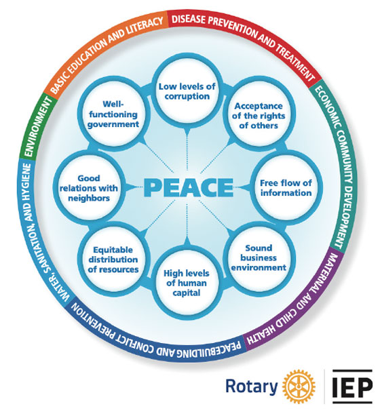
As many of you know, one of my key focuses in life - and as your District Governor - is on creating peace in the world. Peace can have many definitions and be experienced at many levels, and as I see it, virtually all we do as Rotarians in our communities and the world help us build peace. The article that follows provides some of Rotary's perspectives on peace.
The Eight Pillars of Peace
Rotary invests in peace education and capacity building, fosters strategic relationships, and integrates peacebuilding into all of Rotary’s programs and service. We believe when people work to create peace in their communities, that change can have a global effect.
The concept of Positive Peace, developed by the Institute for Economics and Peace (IEP), goes beyond the mere absence of violence (negative peace) to focus on the attitudes, institutions, and structures that prevent conflict and foster societal well-being.
The IEP has identified 8 Pillars of Peace which are interdependent factors that create and sustain peaceful societies by promoting justice, equity, and resilience.
The eight pillars are empirically derived from global data and are mutually reinforcing, meaning that strengthening one pillar can positively influence the others.
While we are having an increased focus on how our work impacts peace in our communities, RI President Olayinka Babalola has also encouraged us to become more aware of the 8 Pillars of Peace and to incorporate them into our work as much as possible.
The 8 Pillars of Positive Peace matter to Rotary because they translate Rotary’s peacebuilding mission into practical, measurable areas where clubs can take action. They also fit naturally with Rotary’s focus on service, ethical leadership, community partnerships, education, health, economic opportunity, and conflict prevention.
Why they are important to Rotary
- They make peace actionable. Instead of treating peace as an abstract ideal, the pillars show specific conditions that help communities prevent conflict and thrive.
- They align with Rotary’s Areas of Focus. Rotary projects in literacy, clean water, disease prevention, maternal and child health, economic development, and peacebuilding all strengthen one or more pillars.
- They support long-term prevention. Rotary is not only responding to crises; it is helping build the social conditions that make violence, instability, and injustice less likely.
- They encourage partnerships. The pillars point Rotary clubs toward collaboration with schools, governments, nonprofits, businesses, faith groups, and civic leaders.
- They help measure impact. The framework gives clubs a way to connect local service projects to broader peace outcomes.
How Rotary can affect the 8 Pillars
Rotary clubs can influence each pillar through local and international service:
- Well-functioning government
Support civic education, transparent local decision-making, voter education, youth leadership, and public problem-solving forums. - Sound business environment
Mentor entrepreneurs, support job training, promote ethical business practices, and expand economic opportunity for underserved groups. - Equitable distribution of resources
Address food insecurity, healthcare access, education gaps, clean water, and basic needs through targeted service projects. - Acceptance of the rights of others
Promote inclusion, interfaith dialogue, anti-bullying programs, cultural exchange, and respectful community conversations. - Good relations with neighbors
Build trust through community events, dialogue circles, service partnerships, youth exchanges, and projects that bring different groups together. - Free flow of information
Support media literacy, public education campaigns, access to technology, transparent communication, and informed community discussion. - High levels of human capital
Invest in scholarships, literacy, mentoring, vocational training, youth leadership, and health programs that help people reach their potential. - Low levels of corruption
Model ethical leadership, promote accountability in club projects, support transparency, and partner with organizations that practice good governance.
In short, Rotary affects the 8 Pillars by doing what Rotary does best: bringing people together, identifying community needs, building trust, and creating sustainable service projects that improve lives.
August 31, 2026
Comments
This Year’s Posts:
- Oct 7: NAPA's Royal International Ball Returns, Bigger Than Ever
- Oct 7: NAPA Rowtarians Take on the Atlanta Dragon Boat Race
- Oct 7: Dougherty County Brings Books to Community Center
- Oct 1: Introducing GRSP Connect Newsletter
- Oct 1: 29th Annual Mayor’s Corporate Challenge Breaks Records in Alpharetta
- Sep 30: Domestic Violence Awareness Month
- Sep 30: Growing Membership: Increasing Rotary’s Impact
- Sep 30: October ... A Time to Celebrate, Consider Opportunities and Act
- Sep 30: Rotary Means Business Returns to D6900
- Sep 30: Muscogee-Columbus Hosts Oyster Roast
- Sep 28: Atlanta Southern Crescent: Where Tacos Meet Self-Defense!
- Sep 27: Find Your Voice: Why Every Rotarian Should Attend RLI
- Sep 27: Every Act of Service is an Act of Peace
- Sep 27: A Rotary Legacy Four Generations Strong
- Sep 27: Are You Barcelona Bound?
- Sep 27: Two Rotarians. Two Cultures. One Conversation.
- Sep 27: More Than 350 Million Reasons to Give to The Rotary Foundation ...
- Sep 27: World Polio Day - October 24!
- Sep 27: Nominations for 2029-2030 District 6900 District Governor Due By 10/31
- Sep 26: North Cobb - Where Service Meets Social
- Sep 26: North Cobb Joins 9/11 Field of Flags
- Sep 26: Roswell Responds to Michigan Rotarian Request for Help
- Sep 26: Countdown to GLL Founders Day Celebration
- Sep 25: Atlanta West End: Service Above Self on the Westside BeltLine
- Sep 25: Vinings Cumberland Helps Bring Tandem Cycling to Blind Athletes
- Sep 23: We Can Help! Forty Clubs Share Easy Polio Initiatives
- Sep 23: Emory Druid Hills Grant Equals More Than School Supplies
- Sep 4: Maciej Derecki Continues a GRSP Legacy in Newnan
- Sep 3: Henry County Turns Used Medical Equipment into Renewed Independence
- Sep 2: Steve Ivory Joins GRSP Foundation Board
- Sep 2: RYLA Club Registration Now OPEN
- Aug 31: The Eight Pillars of Peace
- Aug 31: Introducing Laura McConatha
- Aug 31: Support Relief Efforts in Nepal
- Aug 31: Join the Return to Oz ... Asheville 2027
- Aug 31: Thank You Rotary People of Action!
- Aug 31: September is Basic Education and Literacy Month
- Aug 31: Georgia Rotary Student Program Celebrates 80 Years of Bringing Nations Together
- Aug 31: East Cobb's Dog Days Run Raises $77,550 for Community
- Aug 28: District Newsletter Editor Wanted for 2027-28 Rotary Year
- Aug 28: 30 Years Running for a Reason
- Aug 26: Roswell’s Big Connect Yields Big Help To Local Causes
- Aug 26: Rotary Clubs Support Life-Changing Cleft Care in Bolivia
- Aug 25: Great Start to a New Contest Year
- Aug 25: The Early Bird Catches the Worm!
- Aug 25: From Idea to Tee Box: Meriwether Rotary Gets Ready to Play “Par for a Purpose”
- Aug 25: Every Rotarian, Better Rotarian
- Aug 25: Columbus-Muscogee Full of Rotary Adventure
- Aug 24: NAPA Gives Back: 205 Backpacks, 205 Kids Ready for School
- Aug 24: Think About This Fundraiser Idea ... and Share Yours
- Aug 24: Paul Harris Lives On!
- Aug 24: Community Awareness: Understanding the Impact of Opioids and Substance Abuse
- Aug 24: Peachtree City Back to School Bash Helps Students Succeed
- Aug 21: North Fulton Installs Landscaping for Habitat Home
- Aug 21: How Far We’ve Come in Such a Short Time!
- Aug 21: Rotary Welcomes 2026-27 RYE Students
- Aug 19: Carrollton-Dawnbreakers Fill Little Free Pantries
- Aug 19: Become a CPR & AED Instructor
- Aug 19: Congratulations to 2026-2027 Competitive Grant Recipients!
- Aug 19: Dougherty County Featured on WALB Town & Country
- Aug 10: Share Your Ideas with Rotary International
- Aug 2: Atlanta Southern Crescent Help Kindergartener Begin School Year with Confidence
- Jul 27: Paulding County Boasts Friendships, Commitment to Community
- Jul 27: North Columbus Completes Clean & Green Sanitation Hub in Nepal
- Jul 27: Off to a Great Start!
- Jul 27: The Start of New Year
- Jul 26: Disaster Relief Appeal
- Jul 25: While We're Talking Polio: Let's Make October 24 Count
- Jul 25: Atlanta Ascent Joins District 6900's Rotary Family
- Jul 25: North Cobb Supports Kids2Leaders Camp; Addresses Hunger Issues
- Jul 25: Welcome the North Cobb Hero Duck!
- Jul 25: Peachtree City Rotary Creates Lasting Impact Through Community Grants and Service
- Jul 25: When History Touches "The Now"
- Jul 25: Join Us at June 2027 Rotary International Convention: Barcelona, Spain
- Jul 25: New School Year, New Opportunity for Student Voices
- Jul 23: GRSP Elects FY27 Leadership, Honors Emeritus and Welcomes Class of 2026-27
- Jul 23: Why RLI Matters: And Why You Should Be There
- Jul 23: Heart Behind the Pin: Honoring Service and Legacy of Carrollton Rotarian Jim Gill
- Jul 22: Buckhead's Year Begins with Sleeves Rolled Up
- Jul 22: Create Lasting Impact through CPR Training
- Jul 21: Join Us in Honduras ... A Journey of Joy
- Jul 21: NAPA Welcomes DG Cynthia Dorsey Edwards
- Jul 21: Roswell’s “Connections Challenge”
- Jul 21: North Fulton Provides Back Packs and School Supplies
- Jul 20: Three Clubs Partner to Serve The Table on Delk
- Jul 19: Happy 100 Years to RC of Blakely!
- Jul 7: Atlanta Brasil Hosts World Cup Watch Party
- Jul 7: Dunwoody Presents Fourth of July to Remember!
- Jul 7: Griffin Daybreak and Griffin Team Up to Beat the Heat
- Jul 2: Better Than Your Best
- Jul 2: Doggone Good Time Had By All!
- Jul 1: Join Us in Asheville for the 2027 District 6900 District Conference
- Jul 1: Join Us in Asheville for the 2027 District 6900 District Conference
- Jul 1: Thanks for a Year Well Done!
- Jul 1: Rotary International President Visits District 6900
- Jul 1: North Cobb Helps Feed and Refresh the Community
- Jul 1: Welcome to Our New Rotary Year!
- Jul 1: Emory Druid Hills Celebrates Club Leadership
- Jul 1: Welcome Our New RLI Directors